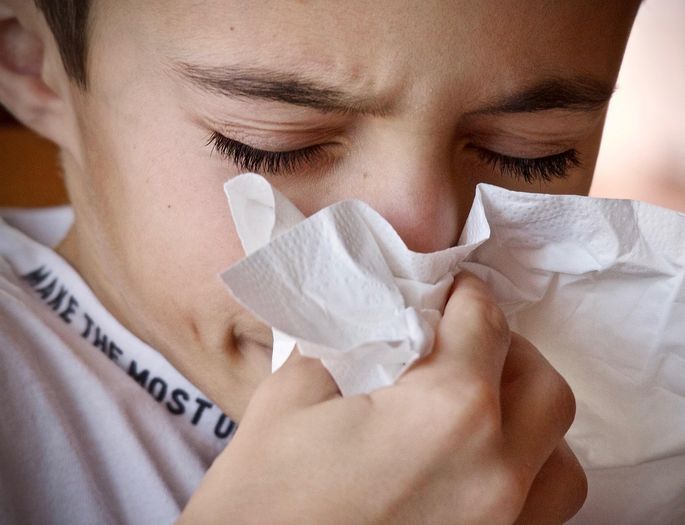
Last year, Poland experienced a massive surge in the cases of whooping cough: incredibly, the number has increased 35 times compared to 2023. This is a trend that can be observed in Europe as well as major countries around the world. ‘For the next several months, the infection rate [in Poland] will remain high’, said Dr hab. Monika Bociąga-Jasik, Prof. UJ from the JU MC Chair in Infectious and Tropical Diseases.
Whooping cough, also known as pertussis or 100-day cough, is an acute, highly infectious respiratory system disease caused by the Bordetella peritussis bacterium. The disease is airborne and much more infectious than COVID-19, particularly in its initial stages, and if left untreated, it may remain so for as much as three weeks. The sick suffer from coughing fits which frequently end with a whooping sound when they breathe in – hence the name. The illness can be quite severe and in fringe cases may even lead to death. Whooping cough is particularly dangerous to infants (because of their undeveloped immune system) and the elderly over the age of 65. In place of coughing fits, newborns and infants often experience apnoea, and sometimes seizures. Currently, the pertussis is mostly spread between teenagers and adults, who subsequently infect children.
Doctors had been expecting a surge in whooping cough cases since even before the COVID-19 pandemic, as the disease comes in waves every few years. In Poland, the last such increase happened in 2016, when over 6,800 cases were reported by the authorities. The next wave should have happened in 2020, but it was stopped by the pandemic restrictions. In 2024, the reported number rose to 32,430. As if this number was not staggering, there is more unsettling news. According to data provided by the National Institute of Public Health, there were 1,201 reported cases of whooping cough in the first half of January.
The figures in Europe and around the world are similar. For instance, according to official data provided by the US Center for Disease Control, the number of recorded cases of pertussis in 2024 reached about 60,000. The Center’s Australian counterpart notes a similar figure of about 52,000 for that same year.
The World Health Organization recommends vaccination as the most effective way of preventing the disease. Vaccines provide long-lasting protection and reduce the risk of complications. The first dose can be administered as early as in the first few weeks of life. Booster shots are also recommended every several years in order to retain immunity. In Poland, the government’s response to the rise of whooping cough cases will be to introduce a ‘pertussis medical package’, currently developed by the Chief Sanitary Inspectorate.
‘Every initiative that increases vaccination coverage levels of adult population can greatly contribute to minimising the number of total cases, which makes Chief Sanitary Inspectorate’s task a critical one. In recent years, we’ve been seeing a dangerous trend of opting out of vaccination. Many people have forgotten how dangerous infectious diseases are and how serious their consequences can be. For many years, there have been no deaths related to pertussis in Poland thanks to our effective vaccination programme. However, as of now, the vaccination rate for children following the mandatory vaccination schedule is only 80%. Meanwhile, adults aren’t getting their booster shots, as most people forget vaccination doesn’t protect them for the rest of their lives’, said Dr hab. Monika Bociąga-Jasik, Prof. UJ.
Since 15 October 2024, pregnant women in Poland can get vaccinated for pertussis in primary health care centres. Sadly, there is very little interest in this initiative. Many women still think getting vaccinated during the child’s prenatal development may harm the child. This is not true, as the vaccinated mother passes her antibodies on to her baby. ‘It’s sometimes difficult for people to understand and I’m not really sure why. Vaccinating against whooping cough is safe and doesn’t lead to any complications for the child’s growth. It’s recommended for women in the third trimester, before the 36th week of pregnancy. It’s a combination vaccine that protects against diphtheria, tetanus and pertussis. It provides protection not only for women, but primarily for their children, who can’t be vaccinated for whooping cough before they’re six weeks old. This protection is crucial during the period when they’re the most vulnerable to complications’, stated Dr hab. Bociąga-Jasik.
‘We need to make it known to people that immunisation is the most effective way of preventing infectious diseases. In 2019, the World Health Organization recognised the decline in vaccinations as one of the greatest threats to health care around the world. Distrust towards vaccinations is exacerbated by the anti-vaxxer movement and social media disinformation. Therefore, it’s vital to involve experts who will rationally and calmly explain the dangers of diseases such as measles, polio and pertussis. A lot of people mistakenly believe these illnesses no longer exist, leading them to think vaccination is redundant and only carry the risk of complications. That’s why social campaigns, in particular those that can reach young people, are so important. During my lectures, I teach students how to talk to people who question the necessity of vaccinations’, JU researcher said.
‘For many infectious diseases, there is simply no effective treatment. This is why vaccinations are so important. People are often oblivious as to how serious these illnesses are, so we have to constantly remind them about it’, Dr hab. Bociąga-Jasik added.