Researchers from the JU Małopolska Centre of Biotechnology have developed an innovative nanoparticle that may serve as the foundation for a universal vaccine. By combining a bacteriophage capsid with SARS-CoV-2 antigens and immune response-enhancing elements, the new technology allows for rapid adaptation of the formulation to emerging pathogens. The structural component of the project was carried out at the cryo-electron microscopy facility of the SOLARIS synchrotron.
The team engineered a nanoparticle based on the MS2 bacteriophage capsid, stripped of its genetic material and functionalised with the SARS-CoV-2 Receptor Binding Domain (RBD) protein. Under the leadership of Dr Antonina Naskalska, the researchers equipped the nanoparticles with elements designed to enhance immune response: short single-stranded DNA fragments or longer, coding mRNA sequences. The nanoparticle was designed in a modular fashion, allowing for the replacement of surface-exposed antigens or molecules encapsulated within the capsid. This modularity enables rapid adaptation of the vaccine to newly emerging pathogens or viral variants.
A key feature of the prototype vaccine is the trimeric form of the RBD protein, which mirrors its natural structure in the SARS-CoV-2 virus. Immunisation with such an antigen increases the likelihood of producing effective antibodies capable of protecting the host from infection. The presence of the trimeric RBD on the nanoparticle surface was confirmed through cryo-electron microscopy studies conducted at the National Synchrotron Radiation Centre SOLARIS.
The results of Dr Naskalska’s team were published in the International Journal of Pharmaceutics in the article Cargo loading and surface display using enlarged MS2 virus-like particles. Co-authors of the study include Marta Walczak, Agnieszka Dąbrowska, Dr inż. Michał Bochenek, Dr hab. Artur Biela, Prof. UJ, and Prof. Jonathan Heddle.
The research was funded by the National Science Centre and a grant from the Ministry of Science and Higher Education for the project ‘Support for research and development using the infrastructure of the National Synchrotron Radiation Centre SOLARIS’.
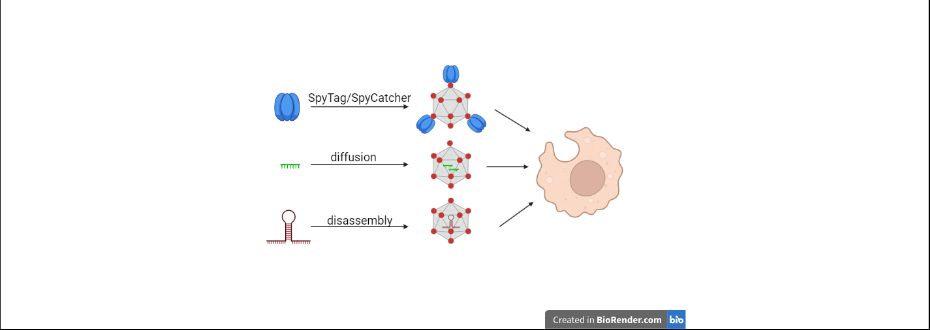
The functionalisation of the phage nanoparticles involved attaching trimeric antigens via the modular SpyTag-SpyCatcher system or encapsulating short single-stranded DNA fragments or longer coding mRNA sequences using either diffusion through the nanoparticle’s pores or disassembly and reassembly of the capsid. These ‘armed’ nanoparticles were introduced into model immune cells in vitro, confirming their potential application as a vaccine.