Scientists from the JU Faculty of Biology as well as the Museum and Institute of Zoology at the Polish Academy of Sciences have shown that some bacteria possess the smallest known non-organellar bacterial genomes. The genomes encode as few as 60 recognisable genes, which is slightly more than one percent of all genes of a typical free-living bacteria and only a half of those found in a typical chloroplast. The results of the study were published in Nature Communications journal.
The size of genome, that is, the amount of DNA and the number of genes, determines the range of functions which the body can independently perform. In most bacteria, the genomes consist of several thousand genes and allow for a relatively independent existence in a changeable environment, whereas bacteria living in a close symbiosis with insects (inhabiting their tissues and providing them with nutrients lacking from food) can function with a much lower number of genes, which results in the loss of their own metabolic capabilities and thus their complete dependence on the host insect, which provides them with key proteins and enables them to perform their vital functions.
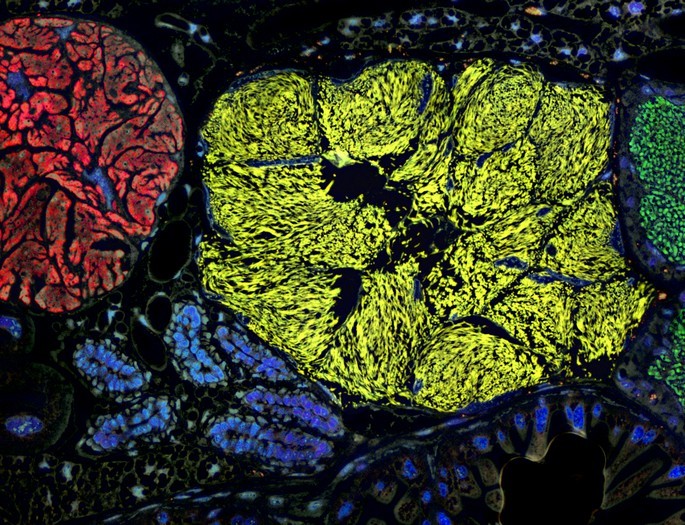
In their research, the scientists, including Prof. Anna Michalik and Dr hab. Piotr Łukasik from the JU Faculty of Biology, focused on symbionts of planthoppers, a diverse group of insects, which includes many crop pests. For more than 260 years these insects remained in close contact with heritable endosymbiotic bacteria. Plant juice, the only food consumed by planthoppers is poor in key nutrients and some crucial amino acids delivered by the symbionts are necessary for their survival.
The researchers analysed the genomes of Candidatus Sulcia muelleri and Candidatus Vidania fulgoroidea – two heritable planthopper symbionts from several dozen species of these insects. In most species the strongly reduced symbionts’ genomes contain a conserved set of genes responsible for the production of amino acids, processing of genetic information and basic elements of metabolism. Yet, in several developmental lineages of planthoppers the reduction of genome went much further during the long-time co-evolution with the host. In most extreme cases the genome of Vidania bacteria consists of only 50-52 thousand pairs of DNA bases and just a little more than sixty protein-encoding genes, which is far fewer than in any other known bacteria genomes. Such reduced genomes retained only a minimal set of genes participating in basic cell processes, which points to their dependence on the host. Their ability to produce nutrients was also reduced: the strains with smallest genomes can produce only one amino acid – phenylalanine, crucial for the formation and hardening of insects’ epidermis, among other things. What is important, is that the thus reduced and very similar genomes have evolved independently in various host lineages, which points to the existence of strong evolutionary constraints and repeatability of the process.
Although the symbiosis has taken place for several hundred million years, studies have shown that the genome reduction process does not always lead to a stable state. In some planthopper lineages, scientists could not fully reconstruct the symbiont’s genomes and the obtained data point to further, extreme changes, such as the fragmentation of genome into small DNA molecules and even the division of one symbiont into separate bacterial lines, which jointly function as an endosymbiont. The pace and direction of these extreme changes depends, inter alia, on host ecology – its diet and lifestyle as well the presence of additional symbiotic microorganisms, which could partially take over the functions lost by the oldest symbionts.
According to the authors of the paper, the results of their research make it possible to better understand how far the genome reduction can go and what minimal functions are needed for the cell to exist and function. The observed bacteria live at the edge of independent cell life and in many resects resemble cell organelles, such as mitochondria or chloroplasts, which also originated from bacteria. The understanding of mechanisms of radical genome reduction is very important for research into the beginnings of life and the minimum requirements for it to emerge, in the context of studies into the origins of life on Earth as well as the search for it outside our planet, as the studies show that life can function in forms much simpler than previously thought, on the condition of close cooperation with other organisms.
The results are also significant for biotechnology and synthetic biology, which for many years have attempted to design cells with minimal genomes. The natural symbiotic systems discussed in the study are unique evolutionary models of ’minimal cells’, which could inspire future applications in medicine, agriculture or industry.
Finally the research highlights the role of relation and interdependence in nature. It shows that evolution does not always lead to greater complexity and independence, but often to deep specialisation and cooperation. The understanding of these systems can also also contribute to protecting biodiversity and stability of ecosystems, where even microscopic organisms play key, though unobvious and inconspicuous, roles.
The article ‘Convergent extreme reductive evolution in ancient planthopper symbioses’ is available on nature.com website.