
The Old Days
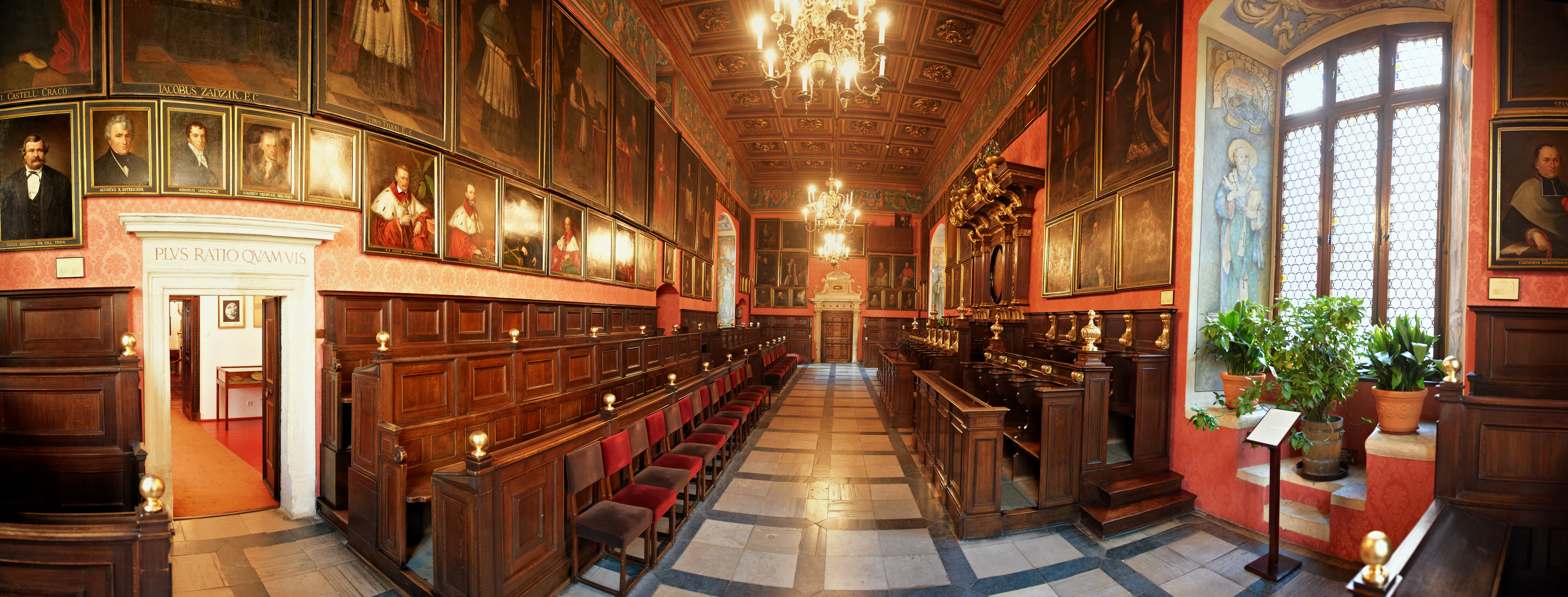
The Kraków University is the oldest higher education institution in Poland and one of the oldest in Europe. It was founded on 12 May 1364 by the Polish king Casimir the Great. The Studium Generale – as the University was then called – comprised three faculties: of liberal arts, medicine and law. Only the former two were active during the founder's life. After the king's death, the University ceased to exist.
Following the failed attempts to restore it in the 1390s, the University was re-founded by King Vladislaus Jagiełło on 26 July 1400. Queen Jadwiga, who died in 1399, contributed to the restoration by leaving a considerable portion of her private estate to the University in her last will. The University's structure was already complete in 1397, with the formal establishment of the faculty of theology. The oldest, main college was at first called the Royal Jagiellonian College (Collegium Regium), and then the Greater College (Collegium Maius). The University, located in the then capital of the Kingdom of Poland, never again interrupted its educational and scholarly activity. Not only does it constitute a symbol of continuity of the Polish state, but also places Kraków among the most important educational centres in the country.

During the 15th century, the University flourished. It attracted learners from all of Europe – every year, some 200 new students enroled. Aside from Poles, the University was also attended by Ruthenians, Lithuanians, Hungarians, Germans, Czechs, the Swiss, the English, the Dutch, the French, the Spanish, Italians, and even Tartars. It was known for providing education in the fields of law, mathematics and astronomy. Among the professors of this age there were two brilliant lawyers – Stanisław of Skarbimierz and Paweł Włodkowic (Paulus Vladimiri) – as well as great mathematicians, astronomers and geographers: Marcin Król of Żurawica, Jan of Głogów, Wojciech of Brudzewo, Maciej of Miechów. The world famous astronomer Nicolaus Copernicus enroled as a student in 1491.
The second half of the 16th century brought crisis. The Reformation and religious division of Europe combined with the creation of many new universities led to a decrease in the influx of foreign students. In Poland admission to important offices was restricted to nobility without a higher education prerequisite, which caused the University to acquire a bourgeois character. In this area, it competed with the new universities in Vilnius and Zamość as well as Jesuit schools. In spite of that, later Polish statesmen, bishops and writers, such as Mikołaj Rej, Jan Kochanowski, Andrzej Frycz Modrzewski, Stanisław Hozjusz and Marcin Kromer studied in this period at the University, which as of late 16th century became known as Kraków Academy.

The 17th century was dominated by the struggle between the Academy and the Jesuits, who desired to seize control of education in Kraków. During that time, the Academy also created a highly developed school system dependent on it (known as the "academic colonies"). Among the scholars of that century, one particularly worth mentioning is the mathematician Jan Brożek. As far as notable students are concerned, John Sobieski, later king of Poland and victor of the 1683 Relief of Vienna, graduated from the Academy in that period.
The establishment of the Commission for National Education in 1773 ushered in a new epoch in the history of the Kraków University. The Commission was the first state body the chief aim of which was the reconstruction of the educational system in Poland. Hugo Kołłątaj was appointed as the reform's executor. He restructured the University during the years 1777–1786. He replaced the four original faculties with two colleges: the Collegium Morale (theology, law and literature) and the Collegium Physicum (mathematics, physics and medicine). He introduced lectures in Polish (with the exception of theology), brought in distinguished scholars (including mathematician and astronomer Jan Śniadecki), furthered the development of natural and exact sciences, and initiated the construction of the astronomical observatory, the botanical garden and the university clinic. During the time of the reform, the University changed its name to the Principal School of the Realm.
In the following years, the historic circumstances caused the University to change its name yet again – to the Principal School of Kraków. After the Third Partition of Poland (1795), Kraków was incorporated into Austria. In 1805, it was joined with Lviv University and Germanised. Re-Polonisation followed in 1809, when Kraków was incorporated into the Grand Duchy of Warsaw. After the Congress of Vienna in 1815, Kraków attained the status of an independent state as the Free City of Kraków, in which the university professors gained a considerable political influence. Poles from Austria, Russia and Prussia were welcome to enrol at the University, but the governments of these states hampered the efforts of prospective students. In 1817, the University acquired its modern name: the Jagiellonian University. Following the dissolution of the Free City and the incorporation of Kraków into Austria (1846), the University was reorganised according to the Austrian model and German again became the language of tuition.
A New Era

In the second half of the 19th century, when Austria granted the Poles in Galicia an actual autonomy, crucial changes in the University's situation led to a substantial growth of its scholarly and social significance. Polish was reinstated as the language of tuition. A new main college was erected (Collegium Novum, 1887). There was a rapid development in both sciences and humanities. Several scholars distinguished themselves in diverse academic fields: Józef Szujski and Michał Bobrzyński (known as the creators of the Kraków school of history) in historiography, Stanisław Tarnowski in history of literature, Jan Baudouin de Courtenay in linguistics, Karol Olszewski in chemistry, Zygmunt Wróblewski and Marian Smoluchowski in physics. Students came from the Polish lands of all three partitions and from the Habsburg Monarchy. Apart from Poles, the University attracted Ruthenians, Ukrainians and Belarusians, Czechs, Moravians and other Slavs as well as Jews and Germans – approximately one thousand new students a year. Among them were Bronisław Malinowski, later anthropologist and author of international renown, and Ivo Andrić, later Nobel Laureate in Literature.
After Poland regained its independence in 1918 the development of the Jagiellonian University continued. Over 4 thousand young men and women attended the University. Its importance in that time is evidenced by the names of brilliant philologists (Ignacy Chrzanowski, Kazimierz Nitsch, Tadeusz Sinko), historians (Roman Grodecki, Władysław Konopczyński), archaeologists (Tadeusz Sulimirski), lawyers (Rafał Taubenschlag, Fryderyk Zoll), mathematicians (Stanisław Zaremba, Tadeusz Banachiewicz, Kazimierz Żorawski), chemists (Leon Sternbach Jr., Leon Marchlewski), among others. A Faculty of Agriculture was established (1923), and the Jagiellonian Library was erected (1939).

During the Second World War, on 6th November 1939, Nazi German authorities deceived nearly 180 scholars and staff members of the Jagiellonian University into gathering in Collegium Novum, then brutally arrested and deported them to concentration camps, where several of them have met their death. Another group of scholars, captured as military officers by the Soviets (who invaded Poland on 17 September 1939), was executed by the order of Joseph Stalin in Katyn (1940). The Nazi Germans closed the University. As a result, clandestine education commenced in 1942 for approximately 800 students. One of them was Karol Wojtyła, who later became pope John Paul II.
In 1945, over 5000 students enrolled to the University. Among them was Wisława Szymborska, later poet and Nobel Laureate. It became a safe haven for scholars who had been forced to leave Lviv and Vilnius due to the change of eastern Polish borders as well as those who could not return to Warsaw because of its destruction by Nazi Germans. In the new, communist political reality, the University's structure was subject to many changes. Theological, agricultural and medical faculties were removed. In 1948 the worst period in the post-war history of the Jagiellonian University began – the era of Stalinism. Communist officials prevented some of the well-known scholars from conducting their research, including the philosopher Roman Ingarden, historian Władysław Konopczyński and economist Adam Krzyżanowski. In the following decades political turbulence impacted the history of the Jagiellonian University. The years 1968 and 1981 witnessed waves of student demonstrations against the regime.
Regardless of this, the Jagiellonian University remained an institution where distinguished scholars continued their work in the academic fields of Polish studies (Juliusz Kleiner, Stanisław Pigoń, Kazimierz Wyka), history (Jan Dąbrowski, Henryk Wereszycki), botany (Henryk Niewodniczański), psychology (Stefan Szuman), legal history (Adam Vetulani), law (Ludwik Ehrlich), linguistics (Jerzy Kuryłowicz), astronomy (Kazimierz Kordylewski), molecular biology (Jan Zurzycki), and mathematics (Tadeusz Ważewski, Franciszek Leja, Stanisław Gołąb, Jacek Szarski).
The Modern University

Currently the Jagiellonian University comprises sixteen faculties, including three medical ones, which were reincorporated into the University in 1993 and now form the Medical College. The construction of the Campus of the 600th Anniversary of the Jagiellonian University Revival has been completed. Almost 40 thousand students attend the university each year, 65% of whom are women. Aside from students from the European Union, the University is also attended by visitors from Africa and Asia as well as Eastern European states formed after 1989 (especially Ukraine and Belarus). The University offers 270 programmes of study, some of which are taught in English.
To fulfil its role at a local, national, and international level, an institution such as the Jagiellonian University requires an adequate infrastructure. Hence, a number of large scale construction projects have been carried out recently, such as completing the expansion of the new campus and the resultant relocation of a number of faculties and institutes to their new, modern buildings; the construction of the Nature Education Centre, the Małopolska Centre of Biotechnology, the National Synchrotron Radiation Centre SOLARIS, as well as a new, state-of-the-art University Hospital Complex; the restoration and expansion of Collegium Paderevianum for the Faculty of Philology and the thorough renovation of Collegium Novum and the streets of the ‘University quarter’. The University infrastructure is constantly improved with the aim of creating an ever better environment for scholarly research, teaching and learning.
In accordance with the goals adopted in the Jagiellonian University Strategy 2030, the University fulfils its mission as a sustainable research university and a leading scientific centre, offering excellent education integrated with science and environment, attractive to students and researchers from Europe and the World. Its key goals also include creating a high quality work and education environment following the principle of accessibility for all as well as effective management, prioritising environmentally-friendly solutions.
The Old Days and A New Era:
Krzysztof Stopka
Director of JU Museum, Collegium Maius